
// insight · 25 Oct 2026
The AI bottleneck has moved upstream
AI has sped up engineering, but the bottleneck has moved to deciding what to build and shaping it well enough to build right. That's where the next gains are.
By Amy Johnson · Chief Product Officer
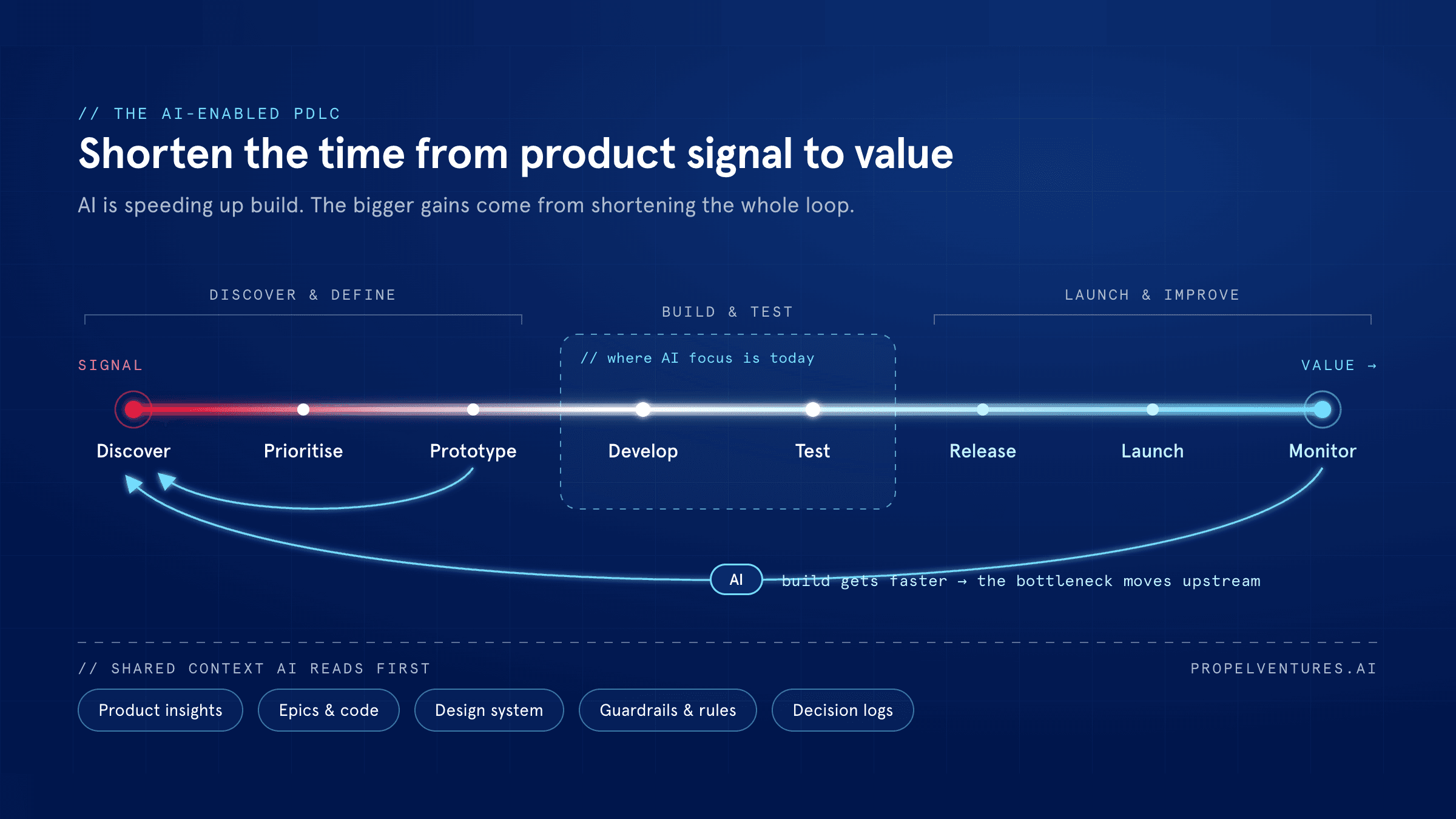
Most organisations’ first wave of AI adoption has landed in engineering. Coding assistants and spec-driven development are shortening the build. Good.
But the bottleneck hasn’t gone. It’s moved – to both ends of the lifecycle. Deciding what to build. And shaping it well enough that engineering builds it right.
Engineering has momentum. The front end doesn’t. Getting from business intent to a design package engineering can build from is still largely manual, document-heavy and reliant on individual effort and memory.
That’s where the next gains are.
Process first, tools second
An AI-enabled product development lifecycle isn’t a tool rollout. It’s a process change. Each step moves onto artefacts that both people and AI can read, so context is carried forward instead of re-created at every hand-off.
The strongest models run a context spine from Intent through Discover, Validate, Explore and Design into Build, Test and Release. Agents create the artefacts. People accept them at defined human gates.
AI does the heavy lifting. People make the decisions.
Start small. Prove it on live work.
You don’t need a transformation program to begin. Pick one product team and one live initiative. Stand up the skills, agents, templates and human gates for the front half of the lifecycle. Prove it on a steel thread, measure the uplift, then turn what works into a pattern other teams can pick up.
Your engineers are already faster. Is the work reaching them getting any better?


Amy Johnson | Chief Product Officer
A product leader, passionate about empowering teams and fostering inclusion. Multi industry experience, now leading the product team at Propel, where we partner with you to accelerate your product development and achieve product market fit faster.