
// insight
Experience counts: inside Propel's IP Atlas
Most AI programs start from a blank page. Yours should not.
By Ben Ross · Founder
Every week a leadership team somewhere commissions an AI pilot that a comparable business finished a year ago. Same function, same workflow, same vendor stack, same lesson learned the hard way at the end. The pilot is run as if nobody had ever done it before, and the organisation pays the full price of discovery for a result that was already known.
That price is not small. A pilot that picks the wrong workflow burns three months and a chunk of executive goodwill. A pilot that picks the right workflow but no baseline cannot prove it worked, so the business case for scaling it never gets written. In our experience those two failures account for most of the AI projects that stall after the first phase.
At Propel we have spent the last two years doing this work across a wide range of businesses, and we have been deliberate about keeping score. We now have a map of where we have been, what we built, what we reused and what it changed. We call it the IP Atlas, and it has changed how we start every new engagement.
Thirteen industries, ten functions, one map
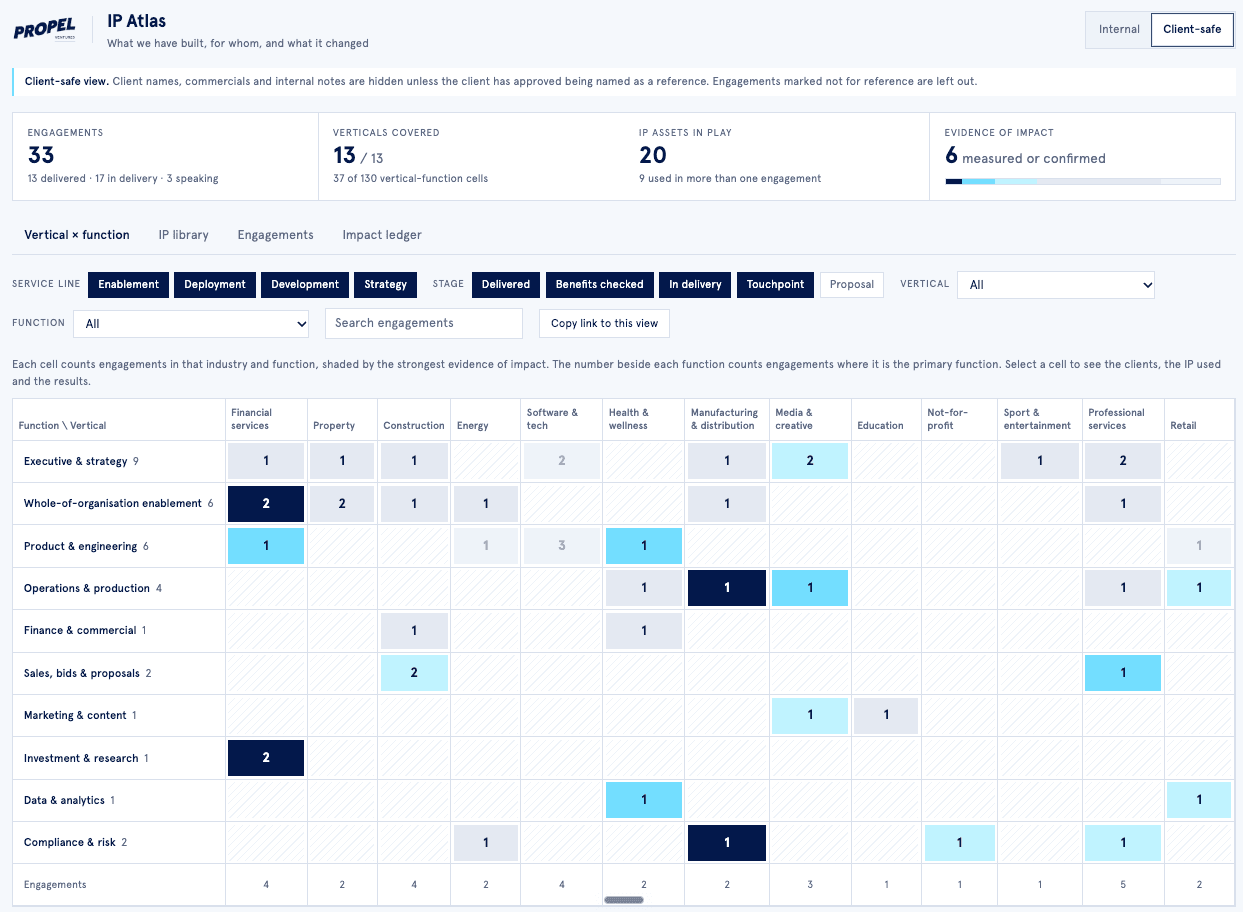
The grid below is the Atlas in one picture. Each column is an industry we have delivered AI work in. Each row is a business function. Each cell counts the engagements that sit at that intersection, shaded by the strength of the evidence behind the result: from activity only, through projected and client-confirmed, to measured.A few things stand out. We have delivered in every one of the thirteen industries on the map, from financial services and property to manufacturing, media and not-for-profit. The work is not confined to the obvious functions: whole-of-organisation enablement and product engineering are busy, but so are operations, compliance, investment research and sales. And the shading is honest. Some cells are dark because the result was measured against a baseline. Many are lighter because the outcome is projected or confirmed by the client in writing, and some record only that the work was done. We show the difference on purpose, because a claim about AI results without the evidence level attached is marketing, not experience.
The count is 33 engagements in the client-safe view, with the pitches and proposals left out. It will be larger by the time you read this, because the Atlas is updated as projects close.
Engagements become IP when you do the work twice
Breadth on its own is only a list of logos. What matters is what accumulates. Behind the grid sits a library of twenty reusable assets that came out of this work, and nine of them have now been used in more than one engagement. Those nine are where the value is, because a method that worked for a second client under different conditions is a method, not a lucky project.
The assets fall into a few types:
- Methods: the Art of the Possible executive session that resets what a leadership team thinks AI can do; the opportunity map and ROI decision pack that turns a long list of ideas into a ranked, costed plan; the desk-side enablement playbook that gets a team using Claude on their real work at about two people per consultant per day.
- Templates and frameworks: an AI governance and safe-use framework that tells staff what can and cannot go into an AI tool, adopted now by clients in five industries.
- Agents and connectors: an inbox order agent that reads customer emails and drafts orders into an ERP; certificate and compliance document automation; a Microsoft 365 connector setup that puts Claude safely inside Outlook, OneDrive and calendars; a claims assessment agent; investment research agents.
- Delivery tooling: an AI-native product delivery lifecycle, with spec-driven development and a way of measuring whether AI is making engineering faster.
Each asset in the library records which engagements used it, where the packaged version lives, who owns it, and what results it produced where it was deployed. That last part is the point of the exercise. We are not collecting slide decks. We are collecting evidence about what works.
What we know before we start
The practical consequence of the Atlas is that we walk into a new engagement knowing three things that a first-timer has to discover.
What to deploy. If you are a distributor keying customer orders from email into an ERP by hand, we have already built the agent that does it, and we know the extraction precision it reached in a proof of concept (81 percent, measured) and what it took to get there. If you are a professional services firm with a hundred staff who have never used an AI tool properly, we know the enablement shape that gets ten out of ten people productive in a week, because we have run it in property, financial services, manufacturing and the arts.
Where to deploy it. The grid tells us which functions in your industry have produced results and which have produced activity. In construction, the money has been in tender scoping and estimation. In financial services, in investment research and whole-of-organisation enablement. In manufacturing and distribution, in operations and compliance. We will still look at your business on its own terms, but we start from a map rather than a blank sheet.
What to expect. Every outcome in the Atlas is recorded in standard units: hours saved per month, cost saved per year, revenue impact per year, payback in months. So when we tell you a tender scoping automation should remove about seventy percent of the manual hours and pay back in around four months, that is the projected business case from a comparable engagement, labelled as projected, not a number invented for the proposal. Where we have a measured result we will say measured. Where we only have activity, we will say that too, and we will set a baseline with you before we start so that next time the answer is measured.
Why experience is the cheapest risk control you can buy
The standard advice on AI risk is about governance: policies, data classification, acceptable use. All necessary, and we build those too. But the risk that costs most organisations money is not a data leak. It is spending six months and a serious budget on the wrong problem, with no baseline, and ending up with a demo nobody can scale.
Prior experience is the control for that risk, and it is hard to fake. A consultancy that has deployed an inbox agent once knows the happy path. One that has deployed it in three businesses knows the failure modes: the supplier whose emails never parse, the ERP field that means something different in each branch, the staff member who stops trusting the draft after one bad order. That knowledge is the IP. It does not show up on a capability slide, and it is the difference between a pilot and a result.
There is a fair counterargument. Reusable IP can become a hammer looking for nails, and a firm with twenty assets has an incentive to sell twenty assets. The Atlas is also our answer to that. Because every asset carries the record of where it did and did not produce a result, we can tell you when the honest answer is that none of our existing IP fits your problem, and what a first-of-kind engagement would cost in time and uncertainty. We would rather say that up front than discover it in month four.
Come and talk to us
If you are planning AI enablement or a deployment in the next twelve months, the most useful first conversation is a short one: show us the function you have in mind, and we will show you the cell on the grid, what was deployed there, and what it returned. If the cell is empty, we will tell you that too.
Experience counts with AI, more than with most technology, because the tools are new and the organisational lessons are not written down anywhere yet. Ours are. Talk to Propel.

Ben Ross | Founder
A product leader and entrepreneur focused on helping businesses apply AI to real commercial problems — from intelligent automation to agent-based systems. An early voice in the field with a 2015 TEDx talk on AI, he now advises executives, product leaders and founders on turning AI ambition into outcomes