
// insight · 27 Nov 2026
What survives when the model eats the app?
If the interface vanished tomorrow and customers reached you only through an agent, what would they still pay for? Thin apps over a customer's own data don't; rules, context and accountability do.
By Amy Johnson · Chief Product Officer
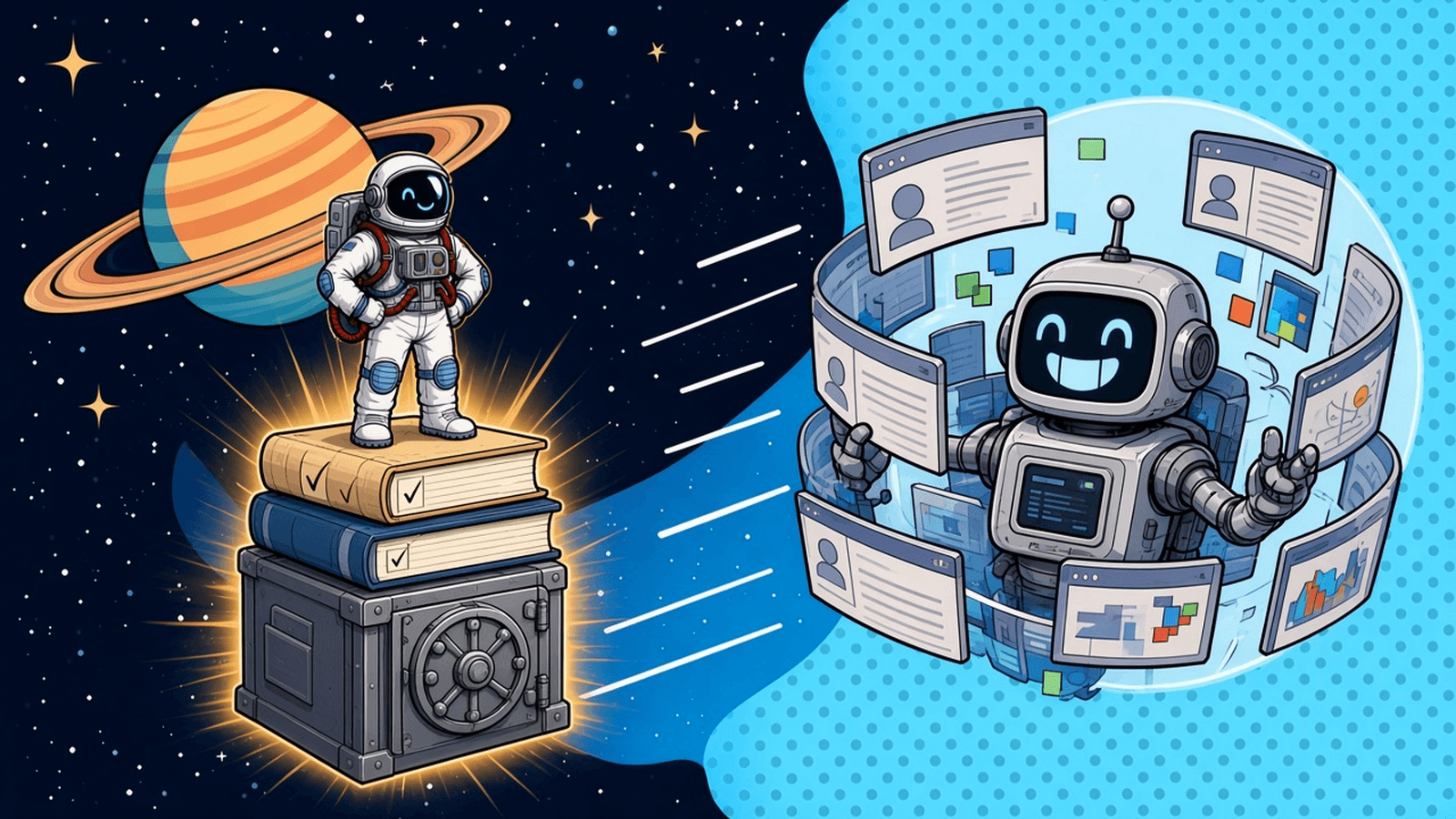
I have been in quite a few conversations lately about whether or not to invest in a product's UX and UI. If agents are running over the data layer, then is solving existing pain points and improving experiences worth the effort?
And therefore, what products are at risk of being replaced?
Prompt-to-app is not new. Us product folk have been having a great time with non-developer tools like Lovable and Replit, shipping working apps for more than a year. What changed this week is where it happens: Anthropic began letting people turn a Claude artifact into something that installs and behaves like a desktop app.
What does this mean for products for which the value is in the interface itself? Where the interface was the product?
Think Typeform, Calendly, Trello, a range of HR systems...
In every case the customer brought the content and the vendor brought a nicer way to work with it. That was worth a subscription because nobody could build the nicer way themselves.
Given it is no longer hard to build, we need to ask:
- Will Anthropic eat our app?
- Should we go headless?
- What is the right commercial model if so?
Salesforce and Atlassian have made two apparently opposite bets on this one.
- Salesforce now exposes the platform through APIs, MCP servers and command-line tools, and it ships inside Claude.
- Atlassian has kept the interface. Mike Cannon-Brookes argues that a vendor who stops investing in its interface will not survive.
Reading past the headlines, both are pouring money into the layer under the interface.
Where they differ is who owns the surface. Salesforce is happy for Claude to be the screen: reps never wanted the clicks, and the data and rules still live in Salesforce. Atlassian believes whoever owns the screen owns the customer.
Maybe each is right for its own product. Salesforce users mostly look things up and enter data. Atlassian users work things out together, so the shared page is where the value is created.
Where the value sits
Take any app-over-data product apart and you find five layers. A model treats each one differently.
- Surface. What it is: Screens, forms, dashboards, the click path. What a model does: Regenerates it on demand, styled to taste.
- Record. What it is: The customer's own data. What a model does: Reads and writes them through any open door, and carries them elsewhere.
- Rules. What it is: Permissions, validation, calculations, compliance logic that must be right every time. What a model does: Calls them. Cannot be trusted to replace them.
- Context. What it is: Relationships, history, exceptions, what happened last time. What a model does: Performs better with it. Cannot invent it.
- Accountability. What it is: Who answers when it is wrong: audit trail, liability, the regulator. What a model does: Cannot hold it.
Surface and record are what apps over data were made of, and both are now cheap. The record always belonged to the customer, and MCP enables a huge value unlock for users.
Rules, context and accountability are different. The models need something deterministic to call.
Context only counts if you capture it and Atlassian says it indexes each agent session and feeds what was learned into the next one.
So where to?
The answer depends on what people actually do in your product. Mike Cannon-Brookes describes four modes of working with agents: chat, delegation, collaboration and pairing. Delegated work can go headless. Collaboration and pairing need a shared surface.
Ultimately, you need something distinctive underneath either a UI or for agents to work with.
We have built an entire resource management system at Propel. For products to survive, there needs to be value in the rules, context or audit trail. We still hook into MYOB (those pesky accounting standards) and HubSpot (useful automations), but no longer need capacity planning or people management software.
Consider this
- Could a capable customer rebuild your product from a prompt and their own export in a weekend?
- What grows more valuable with each use?
- Enabling agentic access is table stakes. Build your MCP and skills, with permissions.
- Keep an interface where you need the human in the loop. Review, approval, exception handling and work between people.
- How will you charge? Reprice before you are forced to. Pick the consumption or outcome metric yourself, while it is still your choice.
- Capture what agents learn to build context that customers value and that helps you improve your product.
So which apps survive? Thin apps over the customer's own data do not. Systems that hold rules, context and accountability do, and they get used significantly more in the new world than they were as clickable interfaces.
Working this through, it's actually not as complex as I first thought - if the interface vanished tomorrow and customers reached you only through an agent, what would they still be paying for?
Amy Johnson | Chief Product Officer
A product leader, passionate about empowering teams and fostering inclusion. Multi industry experience, now leading the product team at Propel, where we partner with you to accelerate your product development and achieve product market fit faster.