// insight · 2 Nov 2026
Which AI model should you use?
AI product work comes back generic when it lacks context, not because of the model. Here's the context layer we build before any skills or agents.
By Amy Johnson · Chief Product Officer
It doesn’t matter as much as what sits in the layer underneath it, so pick one that won’t bankrupt you.
When AI-generated product work comes back generic, it’s rarely the model’s fault, it’s the context it’s lacking. The agent doesn’t know your customers, your past decisions or what “good” looks like in your organisation.
In our AI PDLC work we build the context layer before the skills and agents.
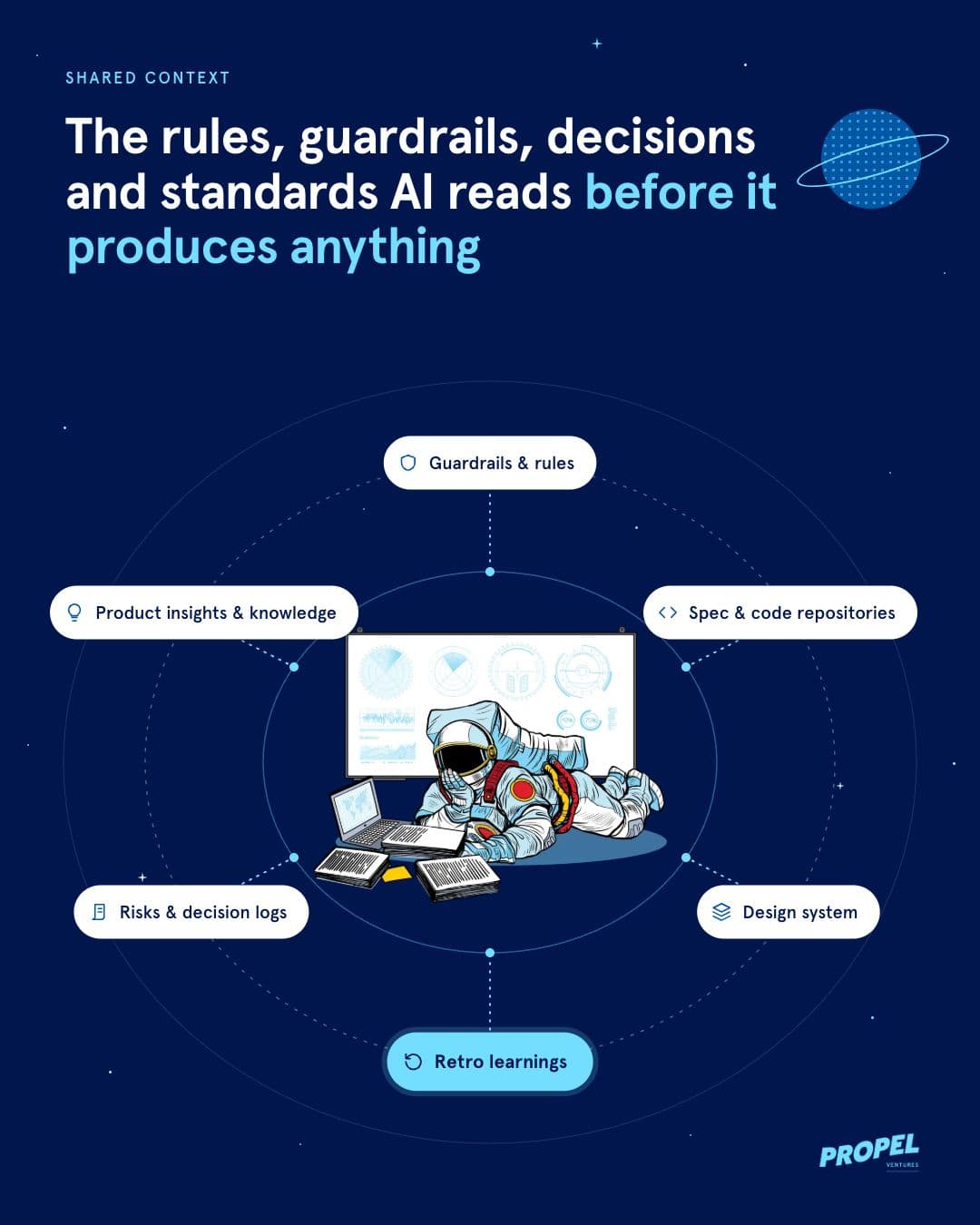
Shared context: This is a single thread of trusted context that runs from opportunity → discovery → validation → design → build → test → release. Each stage produces a structured artefact that both humans and AI can read, and the next stage reads it directly instead of starting from scratch.
- Validated insights: an insights repository in markdown, version-controlled. Research agents propose insights and humans accept or reject them.
- Templates and rubrics: in the same repo. They define what good looks like at each stage, and the critic skills score against them.
- Specs: in GitHub, moving through proposed → in review → approved → implemented, with upstream product documents mapped into each spec.
- Decisions, assumptions and risks: logged by the AI as they come up in conversation, kept in the repo and posted to Slack or Teams so the team sees them.
- Workshop and interview notes: captured in standard session templates so they become usable context, not just meeting notes.
- What people read: published to Confluence, SharePoint or Jira. The repo is the source of truth; those tools are where people consume it.
It fills in layers: team, then domain, then organisation. Every time a human corrects an AI output, that correction goes back in as better context.
That’s why the first cycle feels only slightly faster (or even slower), while the fifth is a different experience. We track cycle time as well as an AI Effectiveness Score: how much of each artefact the AI gets right first time.

Amy Johnson | Chief Product Officer
A product leader, passionate about empowering teams and fostering inclusion. Multi industry experience, now leading the product team at Propel, where we partner with you to accelerate your product development and achieve product market fit faster.